
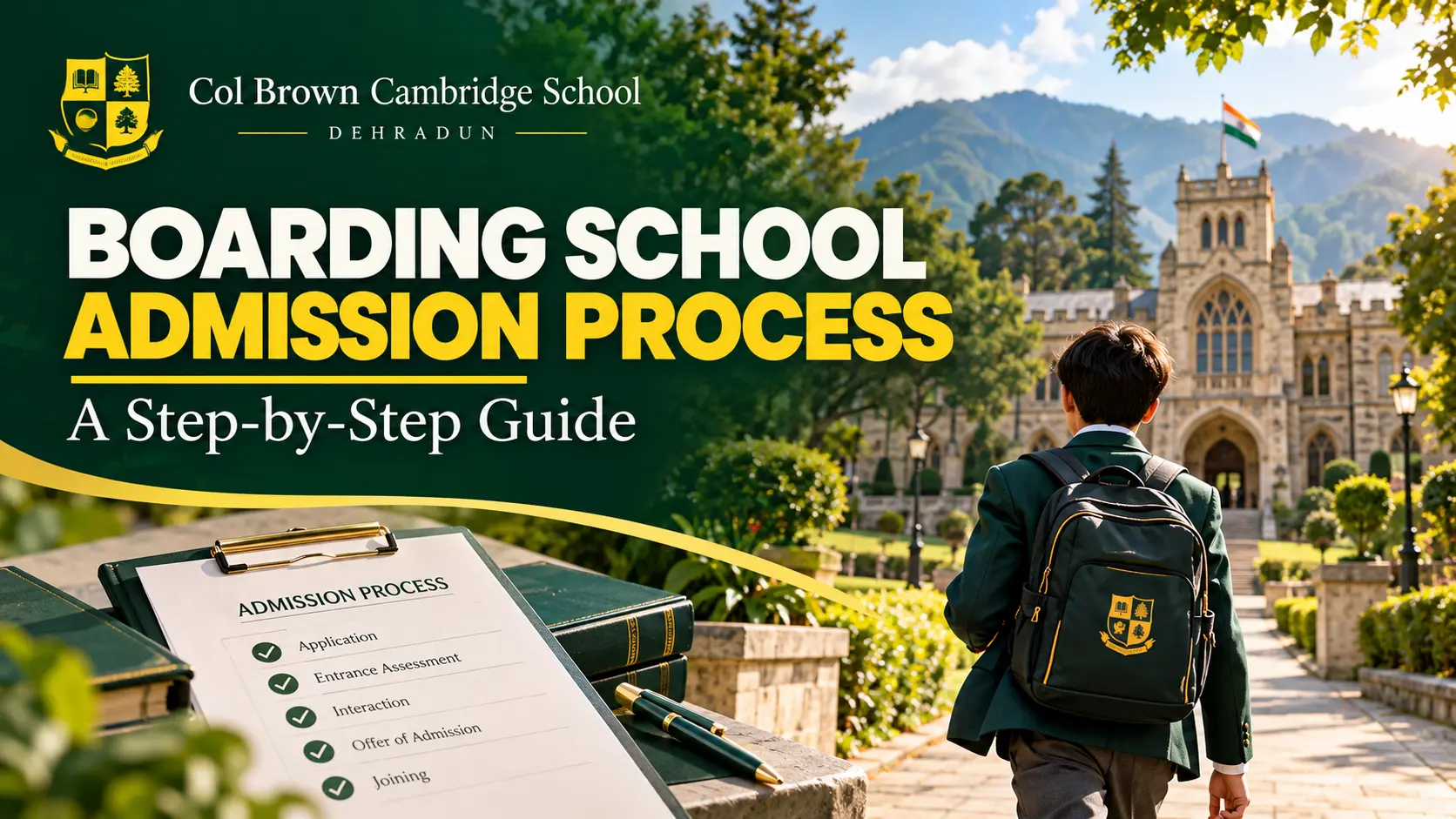
Choosing a boarding school often begins with a simple question: “How do we get admission?” But the real process starts much earlier than filling out an application form.
For parents, boarding school admission is not just about securing a seat. It involves understanding the school’s eligibility requirements, preparing the child for assessments, organising documents, planning finances, and, perhaps most importantly, deciding whether the child is ready for residential school life.
To make the process easier to understand, this guide explains the typical boarding school admission process step by step, using Col. Brown School (CBS), Dehradun, as an example where relevant.
What Is the Boarding School Admission Process?
The boarding school admission process generally involves these stages:
- Researching and shortlisting schools
- Checking eligibility and admission criteria
- Completing registration
- Preparing for the entrance assessment
- Appearing for the interview
- Completing selection and admission formalities
- Planning for the child’s transition to boarding life
Not every boarding school follows exactly the same sequence. Therefore, parents should always check the official admission information of the school they are considering.
Step 1: Shortlist the Right Boarding Schools
Before thinking about forms and entrance tests, take a step back.
Ask whether the school is actually suitable for your child.
Parents can compare schools on factors such as:
- Curriculum and academic approach
- Classes for which admissions are offered
- Boarding and pastoral arrangements
- Sports and co-curricular opportunities
- Medical and student-support facilities
- Location and accessibility
- School values and daily routine
- Fee structure and additional expenses
- Application timeline and availability of seats
A useful approach is to make a comparison sheet rather than relying only on reputation. A school that looks impressive on paper may not necessarily match your child’s academic needs, personality, interests, or readiness for residential life.
Step 2: Check Eligibility and Admission Criteria
Once you have shortlisted a school, the next step is to understand who can apply and what the school expects.
For example, Col. Brown School currently offers admission from Grades IV to XII. Its published admission criteria distinguish between junior and senior school. For Classes IV to VIII, the requirements include passing the previous class, an entrance examination, and an interview. For Classes IX to XII, the school lists a minimum of 60% in Class X, along with an entrance examination, interview, and subject selection.
This is an important point for parents: eligibility requirements can change depending on the class being sought.
Before registering, check:
- Eligible class or grade
- Previous academic requirements
- Minimum marks, if applicable
- Entrance test requirements
- Interview requirements
- Subject or stream requirements for senior classes
Do not assume that the criteria for one class will automatically apply to another.
Step 3: Complete the Registration Form
After confirming eligibility, parents can move to registration.
At CBS, registration is the first formal stage of the admission process. The school provides an online registration facility where parents are required to enter details about the child, including information such as the child’s full name, date of birth, and place of birth.
When completing a boarding school application form, accuracy matters.
Before submitting, check:
- Spelling of the student’s name
- Date of birth
- Previous school details
- Academic information
- Parent or guardian contact details
- Uploaded documents, wherever required
- Payment and registration details
A small error in an application can create unnecessary complications later, so it is worth reviewing the form before submission.
Step 4: Prepare for the Entrance Examination
For many boarding schools, the entrance examination is an important part of the selection process.
But preparation does not necessarily mean making your child study advanced topics far beyond their current level.
A better strategy is to strengthen the fundamentals of the subjects relevant to the child’s class.
A practical preparation approach
Start by reviewing the previous class syllabus. Then focus on:
- Basic concepts in core subjects
- Reading comprehension
- Grammar and written expression
- Mathematical reasoning
- Problem-solving ability
- Time management
Parents can also use sample papers or the syllabus provided by the school after registration, where available. CBS states that its prospectus, sample paper, and syllabus are issued after registration.
The aim should be to build familiarity and confidence rather than turn the admission process into an intense coaching exercise.
Step 5: Prepare Your Child for the Interview
The interview is often the part that makes students most nervous.
It helps to remember what an interview is really trying to establish. Beyond academic performance, a school may want to understand the student’s interests, communication skills, attitude, and readiness for a new environment.
Instead of memorising answers, encourage your child to talk naturally about:
- Favourite subjects
- Hobbies and interests
- Sports or activities
- Books they enjoy
- School experiences
- Why they are interested in boarding school
- What they hope to learn or participate in
Parents should avoid scripting every answer.
A child who speaks honestly and comfortably is generally better prepared than one who has memorised a perfect response.
Step 6: Understand the Selection and Admission Stage
After the required assessments and interview, the school moves to the selection stage according to its admission policy.
This is where parents should carefully read any communication received from the school.
If admission is offered, check the details related to:
- Confirmation of the seat
- Admission fee
- School fees
- Refundable deposits, if applicable
- Joining date
- Required documents
- Uniform and other requirements
- Boarding-related arrangements
For example, CBS currently publishes separate fee components for different class groups. Its 2027–28 fee information lists school fees, a refundable caution deposit, and a non-refundable admission fee, while registration fees differ for online and offline registration. The school also notes that certain expenses may arise separately.
This is why parents should look beyond the headline fee and understand the complete cost of boarding education.
Step 7: Get Ready for Boarding Life
Getting admission is not the end of the process. In many ways, it is the beginning.
A child moving from a day school to a boarding environment may suddenly have to manage routines, personal belongings, study schedules, friendships, and responsibilities with greater independence.
Parents can make the transition easier by discussing boarding life beforehand.
Talk about:
- Daily routines
- Sharing living spaces
- Personal responsibility
- Asking teachers or staff for help
- Staying connected with family
- Managing homesickness
- Participating in activities
It is also useful to let children take part in practical preparations such as organising their belongings and understanding what they will need.
Common Mistakes Parents Should Avoid
Even a straightforward admission process can become stressful when preparation starts too late.
Avoid these common mistakes:
- Checking eligibility too late
- Ignoring class-specific requirements
- Starting entrance preparation without checking the school’s syllabus
- Over-rehearsing interview answers
- Underestimating the total cost
- Choosing a school without assessing the child’s readiness for boarding
A little planning can make the entire experience much more manageable.
A Simple Boarding School Admission Checklist
Before submitting an application, parents can use this quick checklist:
Research → Eligibility → Registration → Entrance Preparation → Interview → Selection → Fee Planning → Joining Preparation
Keep a separate folder, digital or physical, with application details, academic records, payment receipts, important dates, and school communications.
It may seem like a small step, but it makes the admission journey considerably easier to manage.
Final Thoughts
The boarding school admission process does not have to feel complicated. The key is to understand each stage before moving to the next one.
Start with the right questions: Is the school suitable for my child? Does my child meet the admission criteria? What does the entrance assessment involve? How should we prepare for the interview? And is my child ready for residential life?
The example of CBS shows why checking the school’s official requirements matters: admission criteria, registration procedures, assessments, fees, and joining information can be specific to the institution and the class being considered.
Ultimately, successful boarding school admission is not simply about getting through an entrance test. It is about finding the right fit and helping a child step confidently into a new academic and personal chapter.
Frequently Asked Questions
1. What is the difference between weekly boarding and full boarding?
Weekly boarding: students return home on weekends. Full boarding: students stay on campus except during holidays and scheduled breaks. Weekly boarding suits families living nearby.
2. Are students allowed to use mobile phones in boarding school?
Most boarding schools restrict personal phones and gadgets. Students usually call home at scheduled times, so confirm the call timings and device rules beforehand.
3. Who is a housemaster, and what role do they play?
A housemaster or houseparent oversees students’ daily routine, well-being, and discipline in the hostel, and is usually parents’ first contact for everyday concerns.
4. How long does homesickness usually last, and what should parents do?
Homesickness is common in the first few weeks and usually eases as routines and friendships form. Persistent distress should be raised early with staff.
5. How do boarding schools handle food and dietary requirements?
Boarding schools serve scheduled, balanced meals in a dining hall. Share allergies, vegetarian or other dietary needs at admission so the kitchen can plan.