
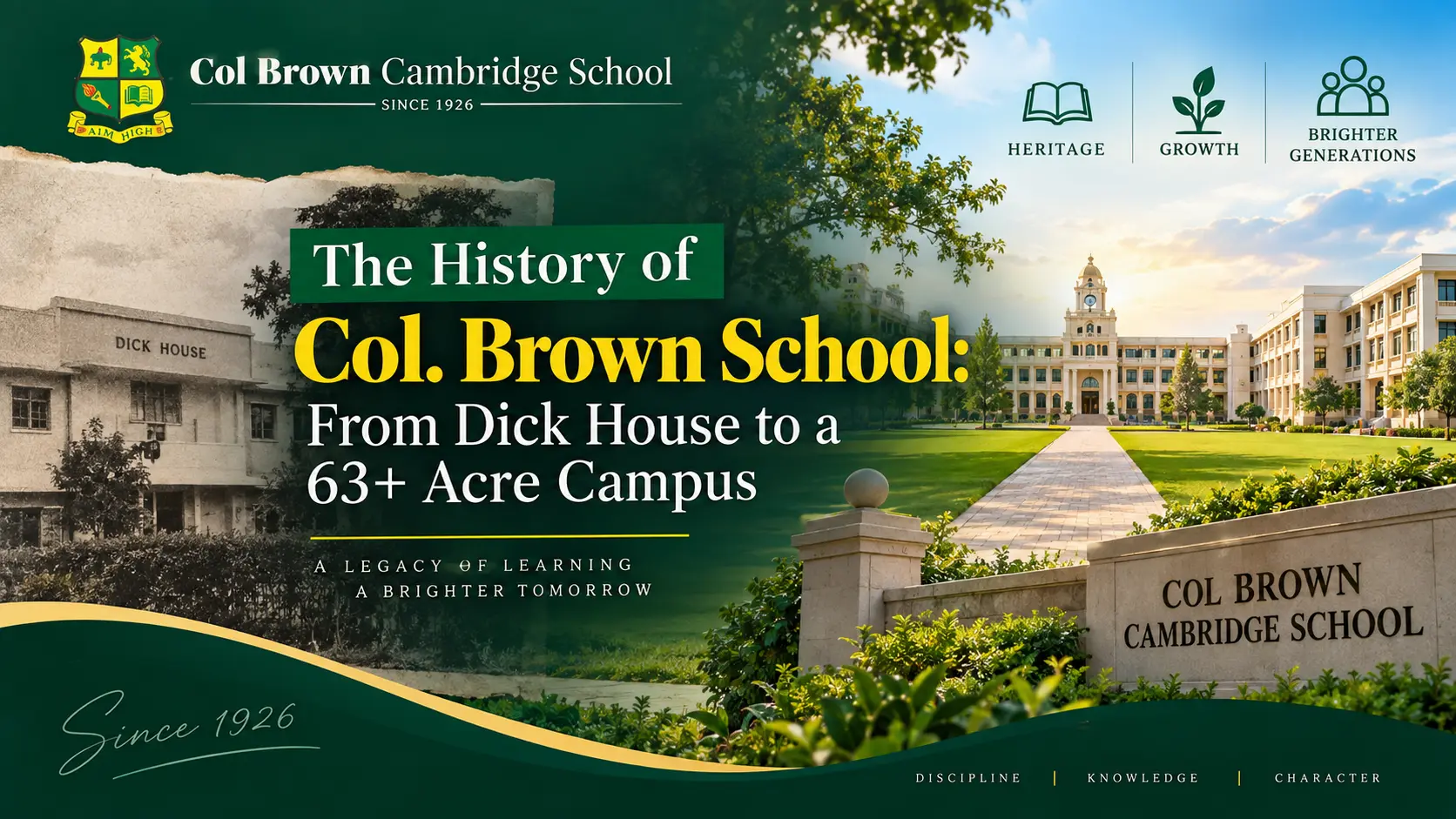
The story of Col. Brown Cambridge School, Dehradun, can be understood not only through its dates and buildings but also through the changing educational vision that shaped its development.
Founded in 1926 by Colonel William Brown and Mrs. Brown, the school began with just five students at Dick House in Dalanwala. Today, the school describes its campus as spread across 63+ acres, with historic buildings, boarding facilities, academic spaces, and extensive green surroundings.
The journey from a small residential school to an established boarding institution is therefore not simply a story of expansion. It is a story of how an educational vision developed over a century.
1926: The Beginning at Dick House
The school’s first chapter unfolded at Dick House, No. 5 Dick Road, Dalanwala, where Colonel William Brown, Mrs. Brown, and five students began the school in 1926.
At the time, Dalanwala and the area around the Rispana River were associated with tea estates. The school therefore began in a setting closely connected with the area’s agricultural landscape. More importantly, it started as a residential institution, with education and daily life centred around the same property.
This modest beginning at Dick House became the starting point for an institution that would gradually expand in both its educational scope and physical infrastructure.
Colonel Brown’s Educational Vision
Colonel William Brown was not simply interested in establishing another school. The school’s official account describes his concern about the unequal educational opportunities available to Indian children during the period.
His vision extended beyond academic instruction. He believed that students needed preparation for employment and participation in a changing society. Discipline, teamwork, character, and practical preparation became important elements of the school’s early educational approach.
The school’s motto, “MAGNA EST VERITAS”—”Truth is Great” became a continuing expression of that philosophy. Its crest features a lion representing courage, a shamrock reflecting its Irish heritage, and a torch symbolising knowledge.
The Early Years: Academics, Sport and Military Preparation
The years following the school’s founding saw its identity develop beyond classroom education. Sport, discipline, and career-oriented preparation became important parts of school life.
Hockey emerged as an early strength, with the school recording its first hockey championship win in 1927. Its connection with the Indian Army also influenced its educational direction. In 1935, pre-IMA classes were introduced, providing preparation for students interested in pursuing military careers.
Meanwhile, admissions grew to include students from prominent Indian, princely, and landed families. These developments helped the school establish a broader reputation while retaining the emphasis on discipline and character associated with Colonel Brown’s educational vision.
1942: The Passing of the Founder
Colonel Brown died suddenly on 18 April 1942. By then, the school had already developed an identity strongly associated with its founder’s educational ideals.
His death marked the end of the founding chapter, but not the end of the philosophy that had shaped the school. The school’s present-day history continues to connect its identity with the values of character, discipline, equality, and education that emerged from its early years.
How the Campus Evolved
The physical development of the school reflects the changing needs of a growing residential institution. As student life expanded beyond the classroom, the campus needed to accommodate academic learning, boarding, sport, recreation, and shared community spaces.
Today, the school describes its campus as covering 63+ acres, with historic buildings and modern facilities set among green surroundings, including lychee and mango orchards. Its boarding infrastructure has also developed over time, with multiple residential houses and dedicated supervision for students.
The campus is therefore more than a measure of physical growth. It reflects how the school gradually developed the spaces needed to support a broader residential and educational experience.
A Century of Growth at a Glance
| Period | Milestone | Why It Matters |
| 1926 | School founded by Col. William Brown and Mrs. Brown | Establishes the school’s residential and educational foundation |
| 1926 | Five students begin at Dick House | Marks the school’s modest beginnings |
| 1927 | First hockey championship win | Marks an early milestone in the school’s sporting history |
| 1935 | Pre-IMA classes introduced | Strengthens the school’s connection with military preparation |
| 1942 | Col. Brown passes away | Marks the end of the founding era |
| 2026 | 63+ acre campus in Dalanwala | Reflects a century of institutional development |
The timeline is based on the school’s official history and current institutional information.
What Makes Col. Brown’s History Distinctive?
What makes Col. Brown Cambridge School’s history distinctive is the way its development reflects the changing needs of education across generations. Its early years combined academic instruction with sport, discipline, and preparation for future careers, while its growth brought a wider student community and a more developed residential environment.
The school’s history also shows how an educational institution can evolve without completely losing the ideas that shaped its beginnings. The buildings, facilities, and scale of the campus have changed considerably, but the historical record continues to connect the school with values such as truth, character, discipline, and responsibility.
Seen in this context, its history is not simply a sequence of milestones. It offers a perspective on how the school’s identity was formed and gradually adapted over time.
A Legacy That Continues to Evolve
A century after its founding, Col. Brown Cambridge School operates in an educational landscape very different from that of 1926. Yet its history provides a clear link between the ideas that shaped its early years and the institution it has become today.
The school has developed considerably in scale, infrastructure, and the scope of student life. At the same time, its historical record shows a continuity of principles that have remained part of its institutional identity.
Seen in this context, the history of Col. Brown is more than a chronology of dates and buildings. It is a record of an educational institution adapting to changing circumstances while carrying forward ideas that have shaped its identity across generations.
FAQs
No. Dick House was originally associated with Colonel Dick and a tea estate before becoming the school’s first home in 1926.
Pre-IMA classes reflected Colonel Brown’s links with the Indian Army and the career opportunities available to students at the time.
The lion, shamrock, and torch represent courage, heritage, and knowledge, complementing the school’s motto, Magna Est Veritas.
He wanted to expand educational opportunities for Indian boys and prepare them for employment and participation in society.
Hockey was closely associated with Colonel Brown, and the school recorded its first hockey championship win in 1927.